JMD Art Gallery Presents “Breath Of The Infinite” A Group Exhibition Of Paintings By 5 Contemporary Renowned Artists

From: January 16 – 31, 2026

JMD Gallery Presents

“Breath of The Infinite”

A Group Exhibition of Paintings by Chetan Katigar, Dinesh Kumar Parmar, Pradip Kumar Sau, Ranjit Kurmi, Santosh Kumar Sandilya

VENUE:

JMD Art Gallery

J – 109, Ansa Industrial Estate,

Saki Vihar Road, Saki Naka,

Near Shiv Sagar Restaurant, Andheri East,

Mumbai, Maharashtra 400072

Phone: 093231 29595 / 09221133506

www.jmdartgallery.com

Timing: 11am to 7pm

Breath of The Infinite

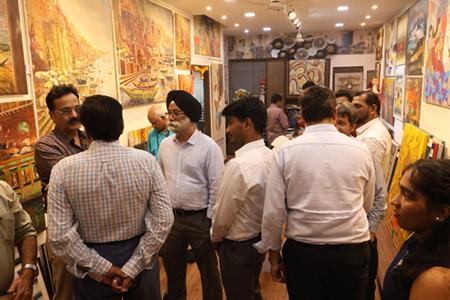
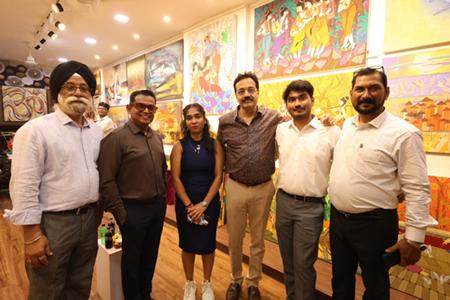
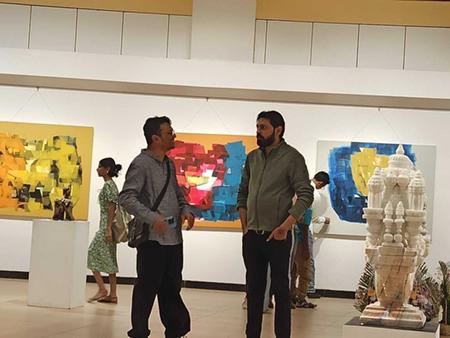
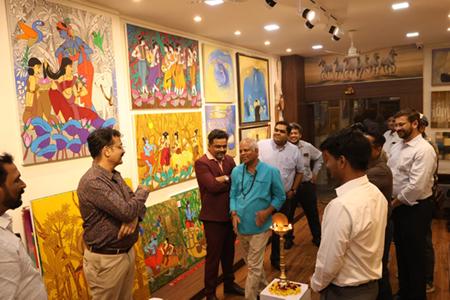
A Group show of Paintings by five contemporary renowned artists – Chetan Katigar, Dinesh Kumar Parmar, Pradip Kumar Sau, Ranjit Kurmi, Santosh Kumar Sandilya will be displayed at JMD Art Gallery, J-109, Ansa Industrial Estate, Saki Naka, Andheri(West), Mumbai from 16th to 31st January 2026 between 11am to 7pm.

Santosh Kumar Sandilya paints Kashi not as a picturesque city but as a living cosmology, where architecture, river, boats, and human ritual are bound into one breathing organism. Working with Ganga -jal as both medium and meaning, his layered ghats turn Varanasi into a site where faith, time, and everyday life flow through the same visual bloodstream.

Ranjit Kurmi’s abstraction moves like a charged weather system; bands of colour collide, fracture, and recombine, producing a painterly turbulence that feels both lyrical and volatile. His canvases hold the tension between structure and release, where pigment behaves like memory in motion rather than fixed form.

Chetan Katigar builds a lush narrative theatre where myth, music, flora, and human presence fold into a single ornamental rhythm, giving devotional storytelling the pulse of contemporary colour. His figurative worlds feel ceremonial yet intimate, where Krishna, musicians, animals, and forest become a single breathing choreography rather than separate motifs.

Pradip Kumar Sau constructs a metaphysical theatre in blue, where floating heads, ascending triangles amidst celestial bodies, and drifting bodies map the human mind’s restless pull between gravity and transcendence. His paintings stage the psyche as a dream-space in which the finite body strains toward an infinite, luminous elsewhere.

Dinesh Parmar composes memory like a palimpsest; layered fields of colour, fractured faces, and symbolic geometry drifting through one another as if time itself were being slowly repainted. His mixed-media surfaces feel archaeological, where emotion, history, and private myth surface and dissolve in the same breath.

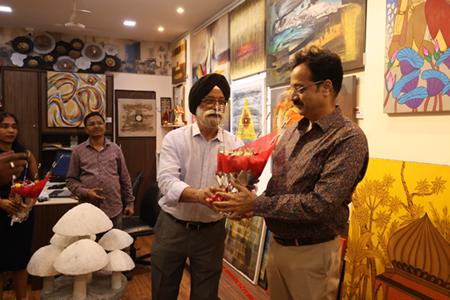
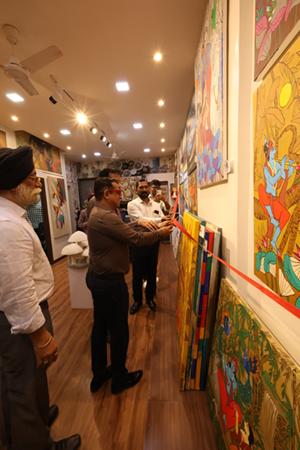
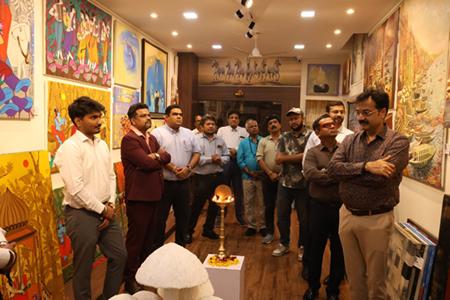
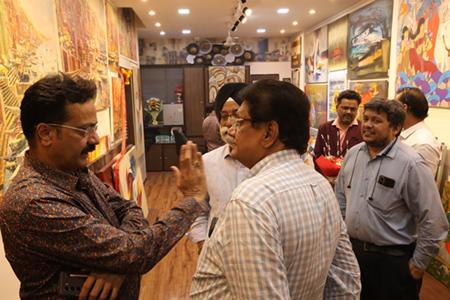
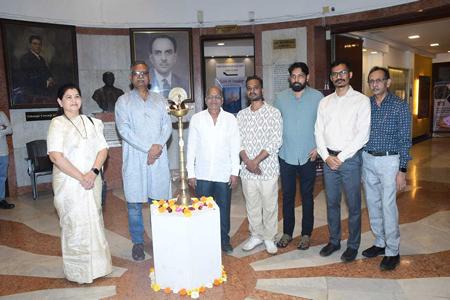
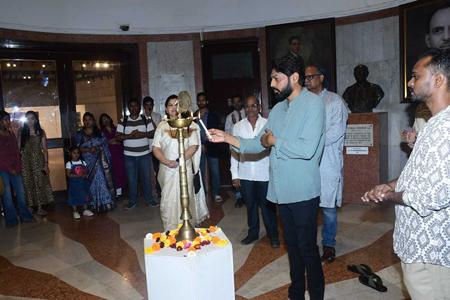
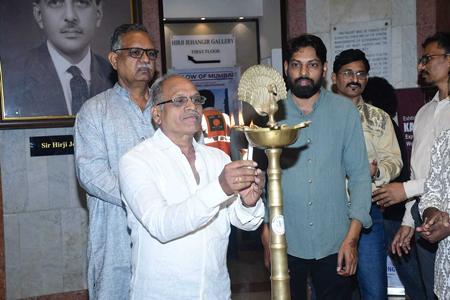
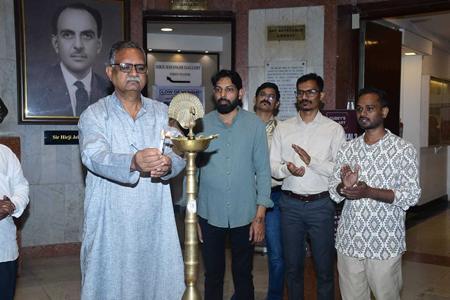
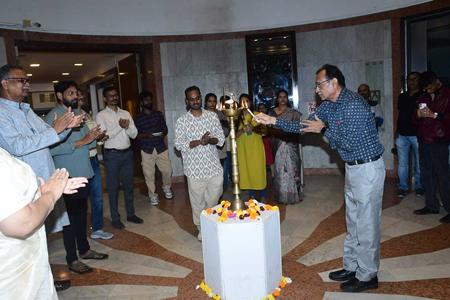
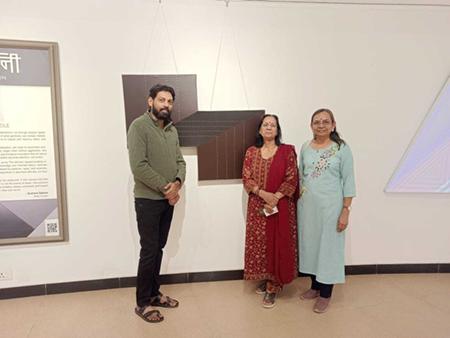
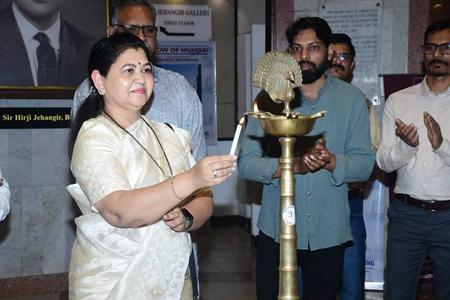
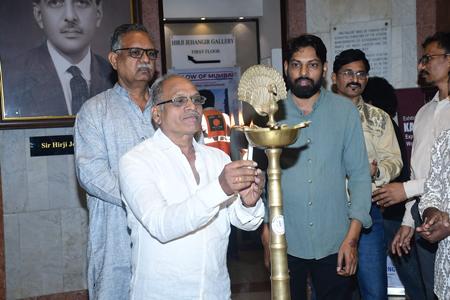
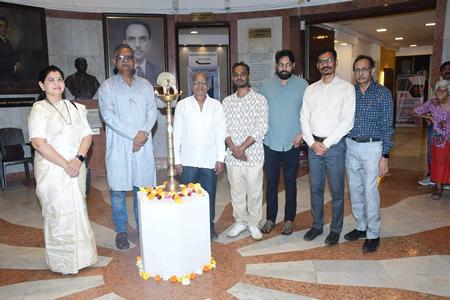
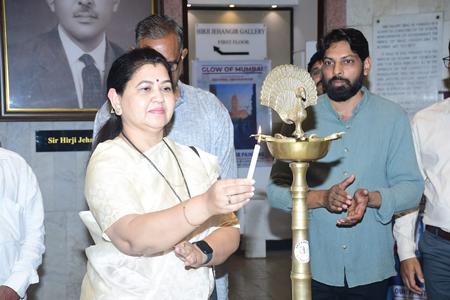
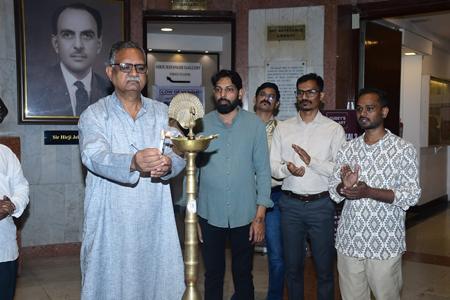
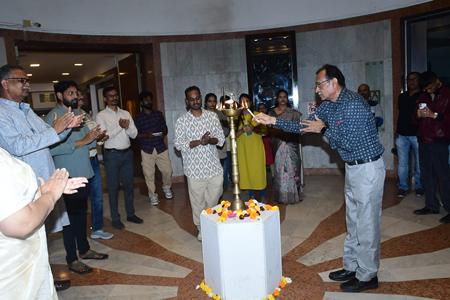
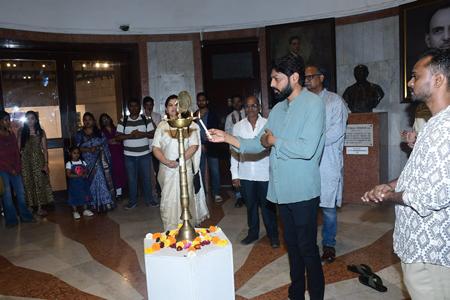
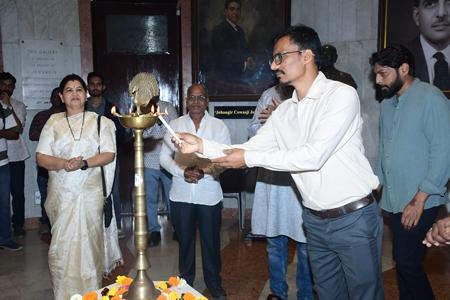
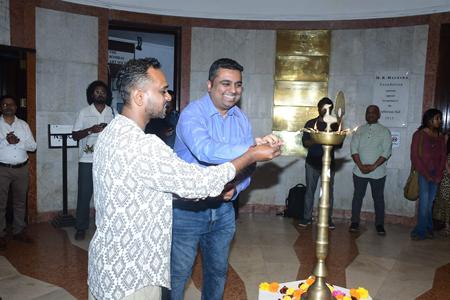
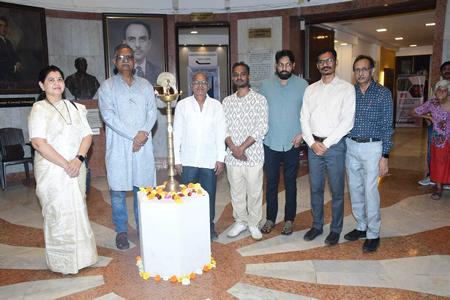
This show was inaugurated on 16th January 2026 by Honourable Guests Mr. Milind Pai(Principal Architect), Mr. Sameer Bhambere(Founder of Lemon Yellow LLP)

—–Sushma Sabnis (Art Curator & Writer)
JMD Art Gallery Presents “Breath Of The Infinite” A Group Exhibition Of Paintings By 5 Contemporary Renowned Artists
“CHITTADARSHANI” Art Exhibition By Contemporary Artist Dhiraj Hadole In Jehangir Art Gallery

From: 23rd to 29th December 2025

“CHITTADARSHANI”

Art Exhibition by contemporary artist Dhiraj Hadole

VENUE:

Jehangir Art Gallery

Auditorium Hall

161-B, M.G. Road

Kala Ghoda, Mumbai 400001

Timing: 11am to 7pm

www.dhirajhadole.com

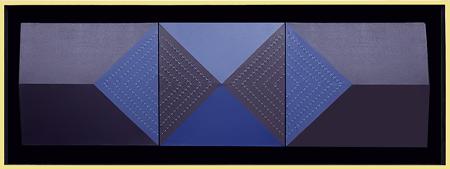
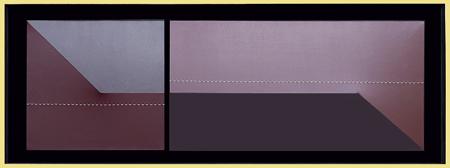
Holding Space: Dhiraj Hadole’s Geometry

Dhiraj Hadole’s work enters the long history of geometric abstraction not through utopian rigidity or formal bravado, but through a quieter, inward recalibration of what geometry can hold within. Where early modernist abstraction like Constructivism, De Stijl, Suprematism, often positioned geometry as a universal language detached from subjectivity, Hadole belongs to a later, more reflective strain of abstractionists that allow structure to coexist with memory, affect, continuity, and care.

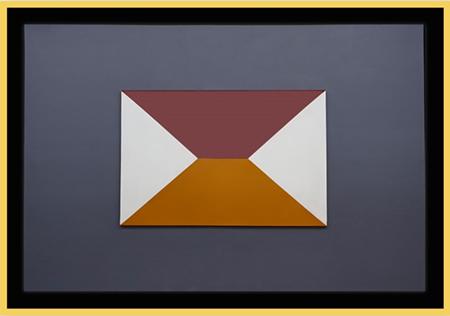
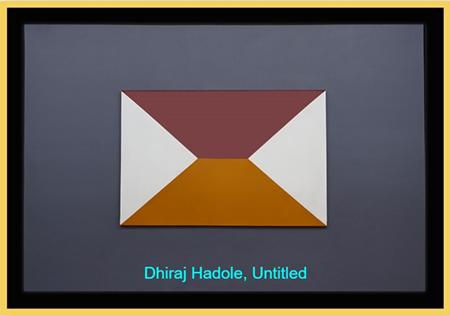
His compositions recall the disciplined clarity of hard-edge abstraction, yet they resist its doctrinaire coolness. Unlike the mathematically assertive geometries of artists such as early Bauhaus painters, Hadole’s planes feel lived-in. They are not declarations; they are settlements. The edges meet without aggression, and colour behaves less like a system and more like a mood. This places his work closer to artists who softened geometry through experience, where colour interaction became psychological rather than purely optical, like Josef Albers.

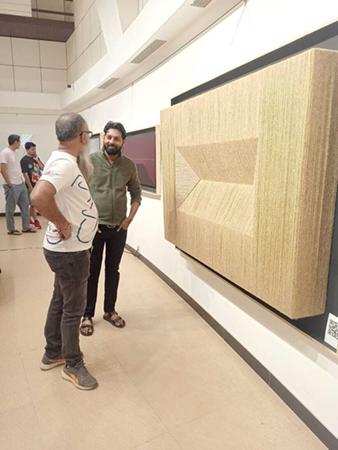
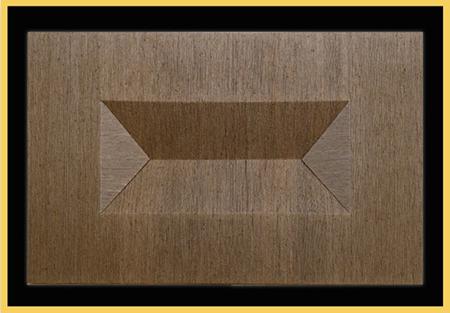
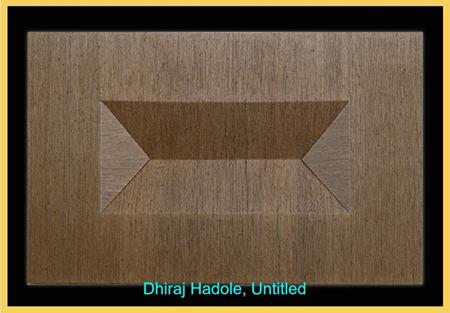
At the same time, Hadole’s surfaces carry an unmistakable emotional register that aligns him with a lineage of felt abstraction, artists who used reduction not to erase feeling, but to distil it. One senses an affinity with quiet grids, where repetition functions as a form of attention rather than control. Hadole treats geometry as a meditative framework, a way to steady the mind rather than dominate it. It is evident in the way he constructs the wood stretcher, and drapes the canvas over it deftly, almost like one was reenacting a childhood memory, shaping it to precision.

The stitched and layered qualities in his work also introduce a material memory absent from classical geometric abstraction. Here, the work quietly diverges from Western modernist purity and moves toward a more indigenous abstraction; one shaped by domestic knowledge, textile logic, and inherited labour. Hadole’s quilt-inspired works situate him within a broader global shift where abstraction absorbs cultural specificity without becoming illustrative of the milieu. The geometry does not reference craft directly, yet it carries its ethics: patience, repair, assembly, warmth.

Emotionally, these works do not aim for expressionism. There is no outburst, no rupture. Instead, they emerge as a feeling that can exist in equilibrium, that care can be structured, that intimacy can be measured without being diminished. This places Hadole in dialogue with post-minimalist sensibilities, where restraint becomes a moral position rather than an aesthetic trick.

What makes Hadole’s paintings quietly radical is their ethics. They insist that stability is not the enemy of life. They argue, without preaching, that a composed surface can still carry intimacy, that precision can still be soft. Dhiraj Hadole’s geometry is not about control for its own sake; it is about building a space where inner turbulence can settle without being forgotten. In that sense, his work aligns with the exhibition’s spirit of Chitta–Chitra: the mind and heart translated into image, not through confession, but through construction.

These are paintings that behave like shelters. They do not shout to be understood. They stay, they steady, and they reward the viewer who is willing to slow down and meet them at their pace.

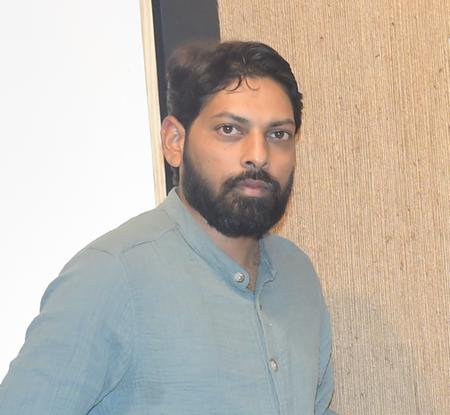
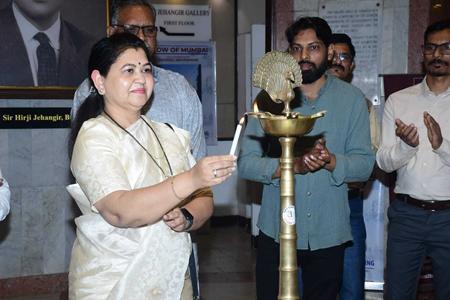
This show was inaugurated on 23rd December 2025 by Honourable Guests –

Adv. Dr. Kirti Kulkarni :Chief Legal Advisor, MAHAGENCO, Special PP, Bombay High COURT, CLA, MSETCL, Ministry of Energy, Govt of Maharashtra  A Panel Adv. MSEB Holding Co. Ltd. Manager Legal, NFDC, Ministry of Information & Broadcasting, Govt. of India, Member, Consumer Court, Mumbai. Asst. Govt Pleader, Writ Cell, Bombay High Court, Mumbai,

Mr. Madhukar Wanjari – Eminent Sculptor

Dr. Narendra Borlepwar – Founder President Aum the Global Art Centre and Aarey Museum, Mumbai,

Amit Shah  :Director – Magnifique Décor and Mangal Movements Mumbai

—-Sushma Sabnis Mumbai (December 2025)

https://www.youtube.com/shorts/zrHgAgREL1k

“CHITTADARSHANI” Art Exhibition By Contemporary Artist Dhiraj Hadole In Jehangir Art Gallery

“CHITTADARSHANI” Art Exhibition By Contemporary Artist Dhiraj Hadole In Jehangir Art Gallery

From: 23rd to 29th December 2025

“CHITTADARSHANI”

Art Exhibition by contemporary artist Dhiraj Hadole

VENUE:

Jehangir Art Gallery

Auditorium Hall

161-B, M.G. Road

Kala Ghoda, Mumbai 400001

Timing: 11am to 7pm

www.dhirajhadole.com

Holding Space: Dhiraj Hadole’s Geometry

Dhiraj Hadole’s work enters the long history of geometric abstraction not through utopian rigidity or formal bravado, but through a quieter, inward recalibration of what geometry can hold within. Where early modernist abstraction like Constructivism, De Stijl, Suprematism, often positioned geometry as a universal language detached from subjectivity, Hadole belongs to a later, more reflective strain of abstractionists that allow structure to coexist with memory, affect, continuity, and care.

His compositions recall the disciplined clarity of hard-edge abstraction, yet they resist its doctrinaire coolness. Unlike the mathematically assertive geometries of artists such as early Bauhaus painters, Hadole’s planes feel lived-in. They are not declarations; they are settlements. The edges meet without aggression, and colour behaves less like a system and more like a mood. This places his work closer to artists who softened geometry through experience, where colour interaction became psychological rather than purely optical, like Josef Albers.

At the same time, Hadole’s surfaces carry an unmistakable emotional register that aligns him with a lineage of felt abstraction, artists who used reduction not to erase feeling, but to distil it. One senses an affinity with quiet grids, where repetition functions as a form of attention rather than control. Hadole treats geometry as a meditative framework, a way to steady the mind rather than dominate it. It is evident in the way he constructs the wood stretcher, and drapes the canvas over it deftly, almost like one was reenacting a childhood memory, shaping it to precision.

The stitched and layered qualities in his work also introduce a material memory absent from classical geometric abstraction. Here, the work quietly diverges from Western modernist purity and moves toward a more indigenous abstraction; one shaped by domestic knowledge, textile logic, and inherited labour. Hadole’s quilt-inspired works situate him within a broader global shift where abstraction absorbs cultural specificity without becoming illustrative of the milieu. The geometry does not reference craft directly, yet it carries its ethics: patience, repair, assembly, warmth.

Emotionally, these works do not aim for expressionism. There is no outburst, no rupture. Instead, they emerge as a feeling that can exist in equilibrium, that care can be structured, that intimacy can be measured without being diminished. This places Hadole in dialogue with post-minimalist sensibilities, where restraint becomes a moral position rather than an aesthetic trick.

What makes Hadole’s paintings quietly radical is their ethics. They insist that stability is not the enemy of life. They argue, without preaching, that a composed surface can still carry intimacy, that precision can still be soft. Dhiraj Hadole’s geometry is not about control for its own sake; it is about building a space where inner turbulence can settle without being forgotten. In that sense, his work aligns with the exhibition’s spirit of Chitta–Chitra: the mind and heart translated into image, not through confession, but through construction.

These are paintings that behave like shelters. They do not shout to be understood. They stay, they steady, and they reward the viewer who is willing to slow down and meet them at their pace.

This show was inaugurated on 23rd December 2025 by Honourable Guests –

Adv. Dr. Kirti Kulkarni :Chief Legal Advisor, MAHAGENCO, Special PP, Bombay High COURT, CLA, MSETCL, Ministry of Energy, Govt of Maharashtra  A Panel Adv. MSEB Holding Co. Ltd. Manager Legal, NFDC, Ministry of Information & Broadcasting, Govt. of India, Member, Consumer Court, Mumbai. Asst. Govt Pleader, Writ Cell, Bombay High Court, Mumbai,

Mr. Madhukar Wanjari – Eminent Sculptor

Dr. Narendra Borlepwar – Founder President Aum the Global Art Centre and Aarey Museum, Mumbai,

Amit Shah  :Director – Magnifique Décor and Mangal Movements Mumbai

—-Sushma Sabnis Mumbai (December 2025)

https://www.youtube.com/shorts/zrHgAgREL1k

“CHITTADARSHANI” Art Exhibition By Contemporary Artist Dhiraj Hadole In Jehangir Art Gallery

“CHITTADARSHANI” An Art Exhibition By Dhiraj Hadole, Pravin Waghmare, Swapnil Sangole At Jehangir Art Gallery

From: 23rd to 29th December 2025

“CHITTADARSHANI”

An Art Exhibition by Dhiraj Hadole, Pravin Waghmare, Swapnil Sangole

VENUE:

Jehangir Art Gallery

Auditorium Hall

161-B, M.G. Road

Kala Ghoda, Mumbai 400001

Timing: 11am to 7pm

Dhiraj Hadole 

Dhiraj Hadole’s work enters the lineage of geometric abstraction not through utopian rigidity or formal bravado, but through a quieter recalibration of what geometry can contain. Hadole belongs to a reflective generation that allows structure to coexist with memory, affect, and care.

His compositions echo the discipline of hard-edge abstraction, yet resist its doctrinaire coolness. The planes feel inhabited rather than imposed; edges meet without aggression, and colour operates as mood. Geometry here is closer to a psychological modulation than an optical one. Reduction does not erase feeling, it distils it. Repetition becomes attention, not control.

Materially, Hadole’s practice departs from modernist purity. The stitched, layered surfaces introduce a tactile memory aligned with domestic knowledge and inherited labour. Quilt-like constructions suggest an indigenous abstraction shaped by patience, repair, and assembly, without slipping into literal craft reference. Cultural specificity is absorbed ethically, not illustrated.

These works propose equilibrium: that intimacy can be measured. In this restraint lies their quiet radicalism. Dhiraj Hadole proves that stability is not the enemy of depth, that precision can remain soft. These are paintings that behave like shelters, steady, composed, and rewarding to those willing to slow down and meet them on their own terms.

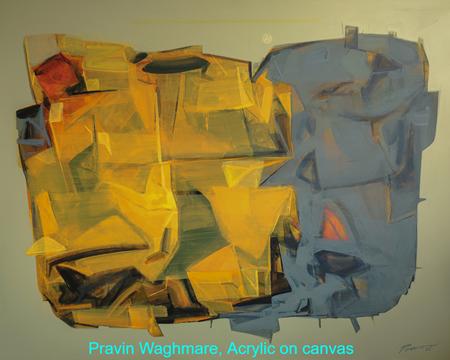
Pravin Waghmare

Pravin Waghmare’s art practice emerges from an acute attentiveness to the visual and emotional residues of everyday life. Forms, colours, textures, and fleeting sensations are not treated as passive observations but as active forces that impress themselves upon the artist’s inner self. From this silent accumulation of experience, Waghmare constructs a language of abstraction that is grounded firmly in lived reality.

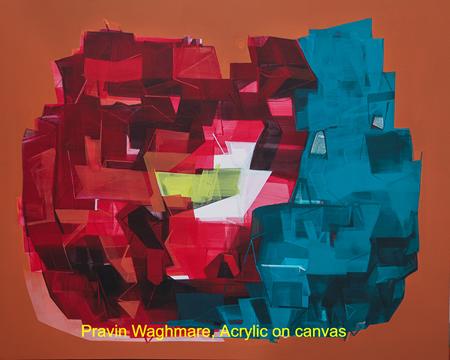
Although his works appear abstract, they are anchored in the rhythms of the visible world, its pauses, frictions, and reverberations. His surfaces carry a sense of return and response: every encounter, whether with nature, society, or the ordinary mechanics of daily existence, rebounds into the pictorial field. This cyclical exchange lends his compositions a quiet intensity, where colour blocks, fractured planes, and layered textures behave like echoes of perception rather than representations of objects.

Waghmare’s use of colour is deliberate and experiential, functioning as a carrier of emotion. Lines and forms unfold through an intuitive yet disciplined process, reflecting an honest negotiation between control and spontaneity. His paintings offer a sustained meditation on how experience transforms into visual thought. Pravin Waghmare articulates abstraction as a deeply human, perceptual act, one that translates the unsaid into form with clarity and depth. 

Swapnil Sangole

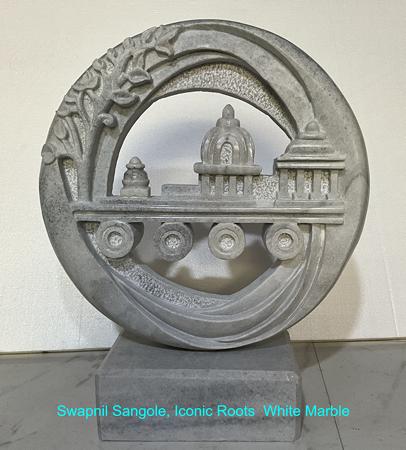
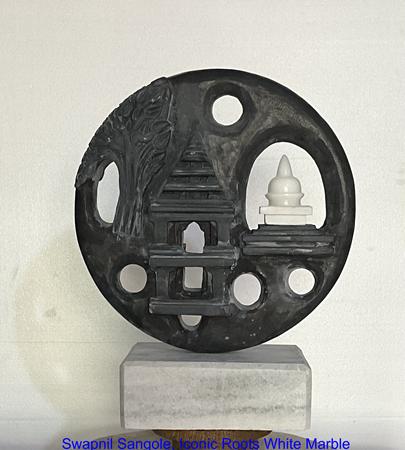
Swapnil Vilasrao Sangole’s sculptures are rooted in a rigorous engagement with material, memory, and metaphysical inquiry. Working primarily with stone, he positions sculpture as a site where permanence and impermanence coexist, where time is both resisted and inscribed. Drawing deeply from Indian temple architecture, Sangole distils their structural intelligence, symbolism and spiritual gravity into a contemporary language.

His works reveal a careful balance between solidity and openness. Carved voids, layered planes, and architectural motifs evoke sacred spaces while remaining resolutely abstract. Each chisel mark becomes a temporal gesture, an assertion of continuity that acknowledges rupture. The stone is listened to, negotiated with, and allowed to assert its own agency within the final form.

Sangole’s sculptures function as thresholds between the material and the metaphysical, inviting tactile contemplation. They are not objects of passive viewing but embodied experiences that ask the viewer to slow down and reckon with scale, weight, and silence. In expanding his practice toward collaborative and community-based projects, Sangole further opens it up to collective memory and shared authorship. Ultimately, his work honours the sacred while confronting contemporary realities. Through restraint, precision, and conceptual clarity, Swapnil Sangole affirms sculpture’s enduring capacity to witness, question, and heal.

This show was inaugurated on 23rd December 2025 by Honourable Guests –

Adv. Dr. Kirti Kulkarni : Chief Legal Advisor, MAHAGENCO, Special PP, Bombay High COURT, CLA, MSETCL, Ministry of Energy, Govt of Maharashtra  A Panel Adv. MSEB Holding Co. Ltd. Manager Legal, NFDC, Ministry of Information & Broadcasting, Govt. of India, Member, Consumer Court, Mumbai. Asst. Govt Pleader, Writ Cell, Bombay High Court, Mumbai,

Mr. Madhukar Wanjari – Eminent Sculptor

Dr. Narendra Borlepwar – Founder President Aum the Global Art Centre and Aarey Museum, Mumbai,

Amit Shah  : Director – Magnifique Décor and Mangal Movements Mumbai

https://www.youtube.com/shorts/CdOI9KaplkQ


“CHITTADARSHANI” An Art Exhibition By Dhiraj Hadole, Pravin Waghmare, Swapnil Sangole At Jehangir Art Gallery


“CHITTADARSHANI” An Art Exhibition By Dhiraj Hadole, Pravin Waghmare, Swapnil Sangole At Jehangir Art Gallery

From: 23rd to 29th December 2025

“CHITTADARSHANI”

An Art Exhibition by Dhiraj Hadole, Pravin Waghmare, Swapnil Sangole

VENUE:

Jehangir Art Gallery

Auditorium Hall

161-B, M.G. Road

Kala Ghoda, Mumbai 400001

Timing: 11am to 7pm

Dhiraj Hadole 

Dhiraj Hadole’s work enters the lineage of geometric abstraction not through utopian rigidity or formal bravado, but through a quieter recalibration of what geometry can contain. Hadole belongs to a reflective generation that allows structure to coexist with memory, affect, and care.

His compositions echo the discipline of hard-edge abstraction, yet resist its doctrinaire coolness. The planes feel inhabited rather than imposed; edges meet without aggression, and colour operates as mood. Geometry here is closer to a psychological modulation than an optical one. Reduction does not erase feeling, it distils it. Repetition becomes attention, not control.

Materially, Hadole’s practice departs from modernist purity. The stitched, layered surfaces introduce a tactile memory aligned with domestic knowledge and inherited labour. Quilt-like constructions suggest an indigenous abstraction shaped by patience, repair, and assembly, without slipping into literal craft reference. Cultural specificity is absorbed ethically, not illustrated.

These works propose equilibrium: that intimacy can be measured. In this restraint lies their quiet radicalism. Dhiraj Hadole proves that stability is not the enemy of depth, that precision can remain soft. These are paintings that behave like shelters, steady, composed, and rewarding to those willing to slow down and meet them on their own terms.

Pravin Waghmare

Pravin Waghmare’s art practice emerges from an acute attentiveness to the visual and emotional residues of everyday life. Forms, colours, textures, and fleeting sensations are not treated as passive observations but as active forces that impress themselves upon the artist’s inner self. From this silent accumulation of experience, Waghmare constructs a language of abstraction that is grounded firmly in lived reality.

Although his works appear abstract, they are anchored in the rhythms of the visible world, its pauses, frictions, and reverberations. His surfaces carry a sense of return and response: every encounter, whether with nature, society, or the ordinary mechanics of daily existence, rebounds into the pictorial field. This cyclical exchange lends his compositions a quiet intensity, where colour blocks, fractured planes, and layered textures behave like echoes of perception rather than representations of objects.

Waghmare’s use of colour is deliberate and experiential, functioning as a carrier of emotion. Lines and forms unfold through an intuitive yet disciplined process, reflecting an honest negotiation between control and spontaneity. His paintings offer a sustained meditation on how experience transforms into visual thought. Pravin Waghmare articulates abstraction as a deeply human, perceptual act, one that translates the unsaid into form with clarity and depth. 

Swapnil Sangole

Swapnil Vilasrao Sangole’s sculptures are rooted in a rigorous engagement with material, memory, and metaphysical inquiry. Working primarily with stone, he positions sculpture as a site where permanence and impermanence coexist, where time is both resisted and inscribed. Drawing deeply from Indian temple architecture, Sangole distils their structural intelligence, symbolism and spiritual gravity into a contemporary language.

His works reveal a careful balance between solidity and openness. Carved voids, layered planes, and architectural motifs evoke sacred spaces while remaining resolutely abstract. Each chisel mark becomes a temporal gesture, an assertion of continuity that acknowledges rupture. The stone is listened to, negotiated with, and allowed to assert its own agency within the final form.

Sangole’s sculptures function as thresholds between the material and the metaphysical, inviting tactile contemplation. They are not objects of passive viewing but embodied experiences that ask the viewer to slow down and reckon with scale, weight, and silence. In expanding his practice toward collaborative and community-based projects, Sangole further opens it up to collective memory and shared authorship. Ultimately, his work honours the sacred while confronting contemporary realities. Through restraint, precision, and conceptual clarity, Swapnil Sangole affirms sculpture’s enduring capacity to witness, question, and heal.

This show was inaugurated on 23rd December 2025 by Honourable Guests –

Adv. Dr. Kirti Kulkarni : Chief Legal Advisor, MAHAGENCO, Special PP, Bombay High COURT, CLA, MSETCL, Ministry of Energy, Govt of Maharashtra  A Panel Adv. MSEB Holding Co. Ltd. Manager Legal, NFDC, Ministry of Information & Broadcasting, Govt. of India, Member, Consumer Court, Mumbai. Asst. Govt Pleader, Writ Cell, Bombay High Court, Mumbai,

Mr. Madhukar Wanjari – Eminent Sculptor

Dr. Narendra Borlepwar – Founder President Aum the Global Art Centre and Aarey Museum, Mumbai,

Amit Shah  : Director – Magnifique Décor and Mangal Movements Mumbai

https://www.youtube.com/shorts/CdOI9KaplkQ


“CHITTADARSHANI” An Art Exhibition By Dhiraj Hadole, Pravin Waghmare, Swapnil Sangole At Jehangir Art Gallery


Coffee Table Book Release And Photography Exhibition MOTHER’S EMBRACE By Devendra Naik In Jehangir

From: 25th to 31st December 2024

“Mother’s Embrace” – the timeless bond of love

A Photography Exhibition by Renowned Photographer Devendra Naik

VENUE:

Jehangir Art Gallery

Terrace Gallery

M.G. Road, Kala Ghoda, Mumbai 400 001

Timing: 11am to 7pm

Contact: +91 9833113555, +91 9920430607  

This exhibition explores the profound bond between a mother and her child, capturing a relationship defined by care, sacrifice, and unconditional love through a series of compelling photographs.


“A mother’s embrace is more than just a physical touch—it’s a profound experience of pure, selfless affection,” says Devendra Naik. Through his lens, he seeks to portray the unseen struggles, quiet sacrifices, and heartfelt moments of a mother’s journey.

The release of Coffee Table book – Chitrakatha and the Photography exhibition was inaugurated on 25 December 2024 by Dr. Ajit Kumar Mohanty – Chairman of Atomic Energy Commission (GOI), Shri Dattatraya Padekar – Renowned Senior Artist, Shri Ashok Bagwe – Renowned poet and author, Shri Kumar Desai – Advocate,  Mumbai High Court, Mr. Parvez Damania and Mrs. Roshani Damania – Businessman, Mr. Mudit Jain  and Mrs. Malti Jain – Businessman, Architect Suchit Gadakari – MD, Sankalpana Designs, Mr. Pranav Vaswani – Director, Felix Schoeller India, Mr. Vishal Dudeja – PR and Marketing, The Lalit Mumbai, Mr. Vimal Parmar – India Editor, Photo Imaging News, Mr. Achal Jain – Fine Art Digital Imaging Pvt Ltd., Mr. Satish Solankurkar – Renowned poet and many others.

This show is curated by Trupti Naik.

What You will Experience:

This exhibition takes you on an emotional journey through themes like:

  • A mother’s relentless pursuit to shape her child’s dreams.
  • Her tireless efforts to balance work and family.
  • Stories of motherhood in tribal traditions.
  • The legacy of nurturing passed down through grandparents.
  • Motherly love in Mother Nature, a nurturing force we often take for granted.

Nature as the Universal Mother 

We call her Mother Nature because, like a mother, she gives selflessly – providing us with life-sustaining resources, shelter, and beauty. She mirrors a mother’s care, strength, and sacrifices. Yet, as humanity prospers, we often neglect and exploit her generosity.

This exhibition sheds light on this delicate relationship, urging viewers to reflect on the ways we can honor and protect the planet we call home. The theme reminds us that nurturing our natural world is as crucial as cherishing the mothers who raise us.

An Invitation to Feel and Reflect 

“Motherhood is not just a relationship; it’s a constant presence guiding us through life’s every phase,” says Devendra. This exhibition invites you to reflect on the true meaning of a mother’s love—be it from the one who gave us life or from the Earth that sustains us.


Coffee Table Book Release And Photography Exhibition MOTHER’S EMBRACE By Devendra Naik In Jehangir

OBLIVION PAGES Solo Show Of Paintings By Well-Known Artist Paul Dmello In Jehangir Art Gallery

From: 25th November to 1st December 2024

“OBLIVION PAGES”

Solo Show of Paintings by well-known artist Paul Dmello

VENUE:

Jehangir Art Gallery

Hirji Gallery

M.G. Road, Kala Ghoda, Mumbai  400 001

Timing: 11am to 7pm.

Contact: +91 9967547953

http://www.pauldmello.com

Email: pauldmello11@gmail.com

OBLIVION PAGES

Recent work of a well-known artist Paul Dmello is showing his solo art exhibition at Hirji Jehangir Art Gallery, M.G. Road, Kala Ghoda, Mumbai 400001 from 25th Nov. to 1st Dec. 2024. This series in Acrylic colours on canvas and water colours on paper will reveal the subtle nuances of the memories of the simplicity of life and peculiarities of beauty of nature and their wonders in the picturesque environment of Vasai and its surroundings.

This show was inaugurated on 25th November 2024 by the Chief Guests – Sameer Sata – Project Director – Reliance Industries Ltd., Mumbai in the presence of Fr. Joe Almeida – Principal, St. Joseph High School & Jr. College, Virar, Vijayraj Bodhankar – Eminent Artist, Journalist & Mentor and Dattatraya Thombre – Principal, Vasai Vikasini Art College, Vasai in presence of art lovers, collectors, promoters etc.

His present series is a visual narrative of societal life capturing the essence of everyday existence in rural areas around Vasai from attire to festivities to agricultural practices to the architecture of yesterday. He has been raised since yesteryears amidst the verdant landscapes of Vasai. Blessed with abundant natural beauty, Vasai has instilled in him a deep rooted admiration for nature since young age.  He grew up in a family of farmers there and has happy good old memories of simplicity of life there. He was mesmerised by the traditional peculiarities in rural life such as flowers, lanterns, grinding wheels, rhythmic sound of rahata – old farming implement charm of ancestral homes with their simple yet intricate carvings with mangalore tiles on the top etc.  Through his series, he has endeavoured to immortalize this heritage ensuring that it remains accessible to future generation. This series serves as a visual narrative of the simplicity of life in that picturesque area as a legacy of Vasai.


OBLIVION PAGES Solo Show Of Paintings By Well-Known Artist Paul Dmello In Jehangir Art Gallery

SAFARNAMA Solo Show Of Paintings By Well-Known Artist Manish Sutaar In Jehangir Art Gallery

From: 26th November to 2nd December 2024

“SAFARNAMA”

Solo Show of Paintings by well-known artist Manish Sutaar

VENUE:

Jehangir Art Gallery

161-B, M.G. Road

Kala Ghoda, Mumbai 400 001

Timing: 11am to 7pm

Contact: +91 9372941458 / +91 9869170967 

SAFARNAMA

Recent work of a well-known artist – Manish Sutaar is showing his recent work in Jehangir Art Gallery, M.G. Road, Kala Ghoda, Mumbai 400 001 from 26th Nov. to 2nd Dec. 2024 between 11 am to 7 pm. This series in Water colours on Archies paper.

Manish Sutaar hails from Mumbai. He had his art education at L.S. School of Arts, Bandra Mumbai upto BFA. Then he displayed his thematic works in numerous leading art galleries in Mumbai, Hyderabad, Pune, New Delhi, New York Biennale, Taipei-Taiwan, etc. He also actively participated in art camps at Hyderabad and Pune. He is a proud recipient of several prizes and awards as well as recognitions from leading art promotional institution of national and international reputations. His works are in collection of many reputed art collectors such as Reserve Bank of India- Mumbai, – New Delhi, Bangalore, Kenya, England, Germany, USA, Paris, New York, Italy etc.

The present series in Water colours on art paper lays emphasis on his journey through life’s canvas as a tapestry of life. It is a chronicle of the ever-shifting landscapes of human existence.  He has encountered a Kaleidoscope of emotions such as joy, sorrow, anger, excitement, enthusiasm, satisfaction in his life. These emphasize profound turmoil and fragile beauty which define the human condition so as to highlight diverse complexity of life in a metropolitan city bustling with hustle & bustle resulting into a pulsating lifeline in urban areas,  Safar transcends more transits leading to a profound metaphor of human aspirations, struggles and fleeting moments. Aptly moved by these moments, his artistic mind has found expressions in colours and forms so as to render unique parameter and dimension to his symbolic exploration of existence via various human postures, moods and unusual characters through flowing forms, textured washes and abstract nuances etc. His quest to unveil and articulate the unseen has resulted into a visual harmony of the intricate complexities of human life.  His canvas has become a refuge where chaos transforms into beauty and despair gives way to hope thereby rendering a happy and positive dimension to his thematic work.


SAFARNAMA Solo Show Of Paintings By Well-Known Artist Manish Sutaar In Jehangir Art Gallery

VOY-AGE Solo Show Of Paintings By Well-Known Artist Swati Roy In Nehru Centre Art Gallery

From: 19th to 25th November 2024

VOY-AGE

Solo Show of Paintings

By

Renowned artist Swati Roy

VENUE:

Nehru Centre Art Gallery

Dr. Annie Besant Road,

Worli, Mumbai 400 018

Timining: 11am to 7pm

Contact: +91 8910812801

Recent work of a luminary from Govt College of Art and Craft and a renowned contemporary artist Swati Roy is showing  in a solo art exhibition at Nehru Centre Art Gallery, Dr. Annie Besant Road, Worli, Mumbai 400 018 from 19th to 25th November 2024. This series made in watercolours on art paper using Gouche technique will exemplify subtle nuances of her skillful application of apt colours in thoughtful pragmatic thematic perceptions.

Swati Roy had her art education upto diploma in fine arts followed by diploma in Indian style drawing and painting from Govt. College of Art and craft, Kolkata. Then she displayed her thematic work in solo and group art exhibitions at renowned galleries all over India such as Academy of Fine Arts, Kolkata, Lalit Kala Academy New Delhi etc.

The present series VOY-AGE highlights subtle nuances of the thematic conceptualizations based on fundamental concepts and their skillful application via apt colour tones to suit thematic peculiarities. Her works have a magical sensibility via essence of both Indian and Western arts. Perfections in her style command over the medium and techniques   adopted and expertise in presenting non figurative abstraction compositions are commendable. Her work is in the genre of classic modernism and expressionism which are bold pictorials of her deepest thought. Her thoughts & Inspiration received from nature find a prominent place in the creative endeavors.

Her faith in phenomenal nature as the ultimate source of forms and configuration, duly reflects in the creation by selection of the recollected memories of the observed contents as configuration of colour-masses with shapes defined by contour lines on dimensional pictorial surface divided into flat colour areas. These shapes and spaces being the residues of images of the phenomenal terrains, sky, land, roads, plants etc become expressive. The various contour lines with which she encloses the shapely colour masses endow the shapes with a strange kind of organic rhythm thereby rendering expressionism to the work. In a way her works are at a junction between representationalism, formalism and expressionism. She has adopted suggestive colours and common symbols upheld by plastic rhythm and inventive shapes. The insistent flowing vegetative rhythms of semi-abstract and abstract combinations find a significant place in her creations which are both eloquent and lucid as well as thematically relevant.

https://youtube.com/shorts/RiDLPCeqoiI?feature=share


VOY-AGE Solo Show Of Paintings By Well-Known Artist Swati Roy In Nehru Centre Art Gallery

TRIPARNA Solo Show Of Paintings By Contemporary Artist Sarang Hundiwala In Nehru Centre Art Gallery

From: 24th to 30th September 2024

“TRIPARNA”

Solo Show of Paintings

By contemporary artist Sarang Hundiwala

VENUE:

Nehru Centre Art Gallery

Dr. Annie Besant Road

Worli, Mumbai 400 018

Timing: 11am to 7pm.

Contact: +91 9422206209

Email:sarang.hundiwala@gmail.com

Aurangabad-based artist Sarang Hundiwala presents a captivating blend of history, spirituality, and artistry in his intricately decorative works. Drawing from a rich array of influences ranging from Indian Miniature art traditions, doodling Zen tangles to Buddhist art influences, mythological frescoes, and traditional Indian sculpture—Sarang’s creations reflect the essence of a realm steeped in cultural heritage and artistic inspiration.

This show was inaugurated on 24th September 2024 by Dr. Uttam Jain Businessman & Member of Film Centre Board in the presence of Sunil Deore renowned sculptor, Mr. Mahendra Kalantri Director Acclaim Systems India Pvt Ltd, Nitin Jadia Art Collector, Mr. Prashant Kashikar MD Mika Engineering Pvt. Ltd., Dr. Jayesh Dakre, Neuroscientist and Smart Future Counsellor, Manmohan Jaiswal Art Curator, Daya Yadav Actor,  Nagma Nizam Singer,  Vaishali Raut Proprietor & entrepreneur, Chhaya Sakhre Classical Singer among others. 

His upcoming solo exhibition, ‘Triparna: The Trinity of Art,’ at the Nehru Centre, Mumbai, exemplifies this unique synergy, offering a visual journey that seamlessly fuses these diverse traditions and popular cultural practices. Each painting invites the viewer into a world of personal religious and spiritual exploration, where Sarang deftly balances the intricate with the ethereal. Central to this collection are his works, which are based on Buddhist sculptures from around the world, starting from the historic Ajanta and Ellora cave art, as well as works from other regions where Buddhism has profoundly shaped culture, religion and philosophy.

Sarang’s works are a meditation on peace, unity, and harmony, embodying the interconnectedness of all life forms—a reflection of the Buddhist principles that anchor his practice. The precision of his penmanship and the subtlety of his brushstrokes create a mesmerising interplay of depth and lightness, leaving viewers enchanted by the richness of his textured surfaces and the inherent depth in their corresponding messages.

With numerous exhibitions to his name, artist Sarang Hundiwala’s art has earned a place in esteemed collections both in India and internationally. His solo show is not just an exhibition; it’s an invitation to experience the timeless spiritual and artistic traditions that continue to inform his evolving visual lexicon and inspire the world around him.


TRIPARNA Solo Show Of Paintings By Contemporary Artist Sarang Hundiwala In Nehru Centre Art Gallery